
Ghana won the Côte d'Ivoire oil field on the sea border
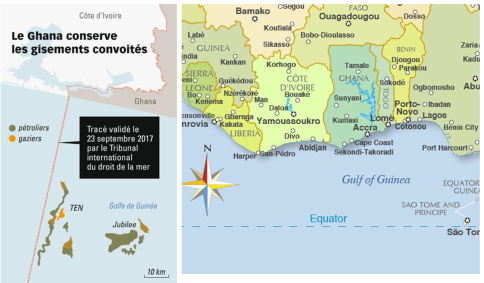
On September 23, 2017, the International Tribunal for the Law of the Sea (ITLOS), located in Hamburg, Germany, decided on the dispute between Ghana and Côte d'Ivoire concerning their maritime boundary in favor of Ghana. Prior to this, the boundary of territorial waters between the two West African countries was not clear defined, it borders on the Ghanaian deposit of Tweneboa-Enyenra-Ntomme (TEN), discovered in 2009 by Tullow Oil.
This decision allowed the British gas-oil company Tullow Oil to resume geological exploration projects in the TEN field. Before the court's decision, this was impossible, because the authorities of the two countries controlled this site, and Tullow Oil received a license for oil production only from Ghana. Therefore, the boss of the company Tullow Oil looked forward to this decision of the court for three years. It untied his hands, because now he has no obligations to revise with Côte d'Ivoire the terms of joint exploitation of TEN, which would be difficult to determine.
Representatives of Côte d'Ivoire were surprised by the judicial outcome, they were confident of their victory. The ITLOS granted most of Ghana's claims, which initiated a judicial procedure in December 2014 to determine the maritime boundary so that it provided Ghana with full ownership of TEN.
The administrations of Tullow Oil claims that it did not interfere in the interstate judicial dispute, but only submitted cartographic maps profitable for Ghana, and has assured the authorities of the two countries that it will take any decision of the court to be able to promote oil projects in the region.
The management of Tullow Oil said that the company plans to drill 13 new oil wells in the TEN field in addition to the already existing 11, and production capacity will be increased from 50,000 barrels per day at the end of 2017 to more than 80,000 barrels a day in two year.
Following the announcement of the court order, Abidjan and Accra promised to respect it, unlike what happened in other similar disputes in sub-Saharan Africa (especially between Cameroon and Nigeria, when in 2002 the latter refused to recognize the court's decision against it).
The management of Tullow Oil evaluates this as a good sign, which will quickly resume the implementation of the company's plans in the two countries. In general, since the establishment in the 1980s, Tullow Oil has viewed the African continent as an open space for its operations and is already present in ten countries in western and eastern Africa.
Tullow Oil has been operating in Côte d'Ivoire for more than 20 years. After the court decision, the company plans to speed up the negotiations with that country about new exploration permits. The company wants to access the Ivorian offshore blocks, especially the CI-524 near the borders of Ghana and the TEN field.
The decision of the ITLOS is extremely important for Tullow Oil financially. The company, in addition to TEN, has also opened and operates a nearby Jubilee deposit in the Ghanaian waters. The significance of this decision is also in the fact that it caused renewed interest of oil companies in the region. Also, the administration of Tullow Oil explained that the lawsuit in Hamburg put the company at great risk, the credibility of it from banks was undermined. After this risk was lifted, the company will be able to establish financial cooperation under the best conditions.
From September 1 to September 27, 2017, Tullow Oil quotations on the London Stock Exchange rose from ₤ 151.10 to 193.40 (from € 164.10 to 220.30).
The Tullow Oil’s leaders hope that the decision of the Hamburg court will mark the beginning of a revival for her. Weakened by the border conflict between Ghana and Côte d'Ivoire, as well as the fall in oil prices and technical problems in the Jubilee field, which caused the company's production in this field to decrease by one third (about 20,000 barrels of oil) in 2016, Tullow Oil was in a bad condition. In addition, in the first half of 2017, the company suffered losses, paying taxes in the amount of $ 309 million (€ 270 million), and also in 2016 was very difficult for the company with a loss of $ 597 million.
After the resale of Ugandan assets to its partner Total in January of this year and the difficulties of developing of its projects in Kenya, in particular to conclude an agreement on the pipeline, the company should concentrate most of its efforts on the zone that has been a priority for her during two decades, it is – West Africa.
The company sharply reduced its costs and reduced borrowed funds during last two years. While Côte d'Ivoire is clearly in sight of Tullow Oil, the company also wants to promote its exploration projects in Mauritania, where its rival and partner Kosmos Energy, with whom Tullow Oil discovered the Jubilee field, has found significant gas reserves.
According to international lawyer Peter Bekker, for litigation, each state spent from $ 500 thousands to 2 millions per year on remuneration of experts and lawyers. In general, it amounted to $ 3 to 6 million for the upper limit - for Ghana, and for the lower limit - for Côte d'Ivoire.
http://www.jeuneafrique.com/mag/478915/economie/ghana-cote-divoire-une-f...
- 1882 просмотра