
Conditions for Doing Business in Cabo Verde

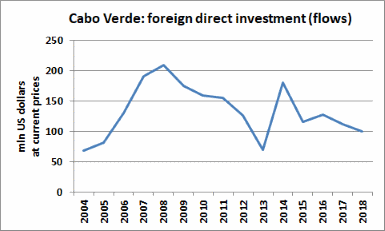
Cabo Verde: flow of FDI in 2018 - 99,6 mln US Dollars (at current prices, UNCTAD)
FDI - Foreign Direct Invetsment
Incentives and Guarantees for foreign investors
The main low which regulate foreign investments juridically in Cabo Verde is External Investment Code (Law 89/IV/93). Besides these code, economic activity for foreign investors is determined in regulatory enactments in corresponding areas.
The institution responsible for the registration, supervision and surveillance of FDI activities in Cabo Verde is the Centro de Promoção Turística dos Investimentos e das Exportações de Cabo Verde (PROMEX).
The Government of Cabo Verde encourages foreign investment, particularly in tourism, fishing,light manufacturing, communications and transportation. All sectors of the economy are open to foreign investment, although approval is required.
Residents and non-residents may hold foreign exchange accounts, subject to government approval and regulations. Most payments and transfers are subject to controls. Real estate transactions require a Central Bank (Banco de Cabo Verde) approval. When permitted the Central Bank must approve most capital transactions in advance.
The Government of Cabo Verde has put in place reforms to streamline the cumbersome bureaucracy and to increase transparency for businesses to set up in Cape Verde. PROMEX has become a one-stop shop for external investors.
Mass privatizations have also eased the burden of competing with state-owned enterprises. The Government of Cabo Verde works to ensure that its economy is integrated in the global economy [UNCTAD. World investment directory. Volume X. Africa. United Nations. N.Y. and Geneva. – 2008, p. 141].
Since 1991, the government has pursued market-oriented economic policies, including an open welcome to foreign investors and a far-reaching privatization programme, free trade zones were created. It established as top development priorities the promotion of a market economy and of the private sector; the development of tourism, light manufacturing industries, and fisheries; and the development of transport, communications, and energy facilities. From 1994 to 2000 about $407 million in foreign investments were made or planned, of which 58% were in tourism, 17% in industry, 4% in infrastructure, and 21% in fisheries and services www.en.wikipedia.org/wiki/Cape_verde#Economy
Cabo Verde is a member of the African Union, World Bank's Multilateral Investment Guarantee Agency (MIGA), New Partnership for Africa's Development and Economic Community of West Africa States. It is also eligible for the United States' market access initiative for African countries - the African Growth and Opportunity Act, the Cotonou Agreement for renegotiating the trade links between the African, Caribbean and Pacific countries with the European Union (EU), the EU's Everything But Arms initiative and the generalized system of preferences for the least developed countries. Cape Verde has an observer status at the World Trade Organization [UNCTAD. World investment directory. Volume X. Africa. United Nations. N.Y. and Geneva. – 2008, p. 141].
Ports and harbors - Mindelo, Praia, Tarrafal
Terminal – Porto Grande.
Airports – 10
Prospects for economic cooperation with Cabo Verde:
- agroindustry;
- processing of foodstuff;
- mining;
- machine building;
- fishing;
- manufacturing;
- chemicals;
- construction;
- energy;
- transportation
- education;
- tourism.
- 2536 reads