
Guinea-Bissau - Economy
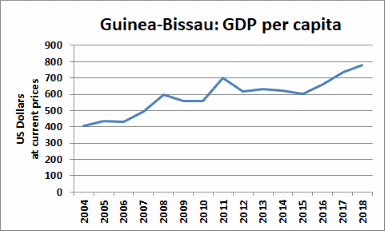

GDP per capita – 779 US dollars (2018, at current prices, UNCTAD).
GDP – 1,5 bln US dollars (2018, at current prices, UNCTAD).
GDP - gross domestic product
Exports (marchandise) – 349 mln US Dollars (2018, at current prices, UNCTAD).
Imports (marchandise) – 330 mln US Dollars (2018, at current prices, UNCTAD).
Exports (services) – 31 mln US Dollars (2018, at current prices, UNCTAD).
Imports (services) – 173 mln US Dollars (2018, at current prices, UNCTAD).
Main export commodities - fish, shrimp; cashew nuts, peanuts, palm kernels, sawn lumber.
Main import commodities - foodstuffs, machinery and transport equipment, petroleum products
Economy overview
One of the six poorest countries in the world, Guinea-Bissau depends mainly on farming and fishing. Cashew crops have increased remarkably in recent years, and the country now ranks fifth in cashew production. Guinea-Bissau exports fish and seafood along with small amounts of peanuts, palm kernels, and timber. Rice is the major crop and staple food. However, intermittent fighting between Senegalese-backed government troops and a military junta destroyed much of the country's infrastructure and caused widespread damage to the economy in 1998; the civil war led to a 28% drop in GDP that year, with partial recovery in 1999-2002. www.cia.gov/library/publications/the-world-factbook/geos/pu.html
Guinea-Bissau has started to show some economic advances after a pact of stability was signed by the main political parties of the country, leading to an IMF-backed structural reform program. The key challenges for the country in the period ahead would be to achieve fiscal discipline, rebuild public administration, improve the economic climate for private investment, and promote economic diversification. After becoming independent from Portugal in 1974 due to the Portuguese Colonial War and the Lisbon's Carnation Revolution, the exodus of the Portuguese civilian, military and political authorities brought tremendous damage to the country's economic infrastructure, social order and standard of living.
After several years of economic downturn and political instability, in 1997, Guinea-Bissau entered the CFA franc monetary system, bringing about some internal monetary stability. The civil war that took place in 1998 and 1999 and a military coup in September 2003 again disrupted economic activity, leaving a substantial part of the economic and social infrastructure in ruins and intensifying the already widespread poverty. Following the parliamentary elections in March 2004 and presidential elections in July 2005, the country is trying to recover from the long period of instability despite a still-fragile political situation www.en.wikipedia.org/wiki/Guinea-Bissau#Economy
Main sectors of economy
The economy depends mainly on agriculture; fish, cashew nuts and ground nuts are its major exports www.en.wikipedia.org/wiki/Guinea-Bissau#Economy
The currency is CFA franc.
CFA - "Communaute Financiere Africaine" (African financial community). Frank CFA has been used since 1945.
Frank CFA (currency code XOF) is the single currency of the regional integration association – the West African Economic and Monetary Union (WAEMU, fr. – L’Union économique et monétaire ouest-africaine UEMOA).
WAEMU members - 8 countries, 7 French-speaking: Benin, Burkina Faso, Côte d'Ivoire, Mali, Niger, Senegal, Togo, 1 Portuguese-speaking: Guinea-Bissau.
The monetary policy of WAEMU is controlled by a regional bank – the Central Bank of the West African States (fr. Banque Centrale des États de l'Afrique de l'Ouest – BCEAO), headquartered in Dakar (Senegal); the franc CFA guarantor is the French treasury.
Frank CFA has a fixed exchange rate to the euro:
1 euro = 655,957 CFA francs.
Frank CFA exists in two variants, each with the same parity to the euro: the CFA franc for the countries of the West African Economic and Monetary Union (currency code XOF) and the CFA franc (currency code XAF) for the countries of the Central African Economic and Monetary Community (CEMAC), which consists of 6 members: Cameroon, Central African Republic, Chad, Republic of Congo, Equatorial Guinea, Gabon.
Although Central African CFA francs and West African CFA francs have the same monetary value against euro, West African CFA coins and banknotes are not accepted in countries using Central African CFA francs, and vice versa.
- 3320 reads