
Liberia - Economy

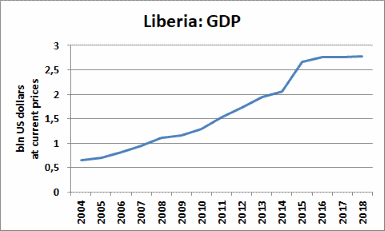
GDP per capita – 577 US dollars (2018, at current prices, UNCTAD).
GDP – 2,8 bln US dollars (2018, at current prices, UNCTAD).
GDP - gross domestic product
Exports (marchandise) – 490 mln US Dollars (2018, at current prices, UNCTAD).
Imports (marchandise) – 1,1 bln US Dollars (2018, at current prices, UNCTAD).
Exports (services) – 73 mln US Dollars (2017, at current prices, UNCTAD).
Imports (services) – 234 bln US Dollars (2017, at current prices, UNCTAD).
Main export commodities - rubber, timber, iron, diamonds, cocoa, coffee.
Main import commodities - fuels, chemicals, machinery, transportation equipment, manufactured goods; foodstuffs.
Economy overview
The First Liberian Civil War in 1989-96 destroyed much of Liberia's economy, especially the infrastructure in and around Monrovia Richly endowed with water, mineral resources, forests, and a climate favorable to agriculture, Liberia had been a producer and exporter of basic products, while local manufacturing, mainly foreign owned, had been small in scope. The democratically elected government, installed in August 1997, inherited massive international debts and currently relies on revenues from its maritime registry to provide the bulk of its foreign exchange earnings. The restoration of the infrastructure and the raising of incomes in this ravaged economy depend on the implementation of sound macro- and micro-economic policies of the new government, including the encouragement of foreign investment.
President Ellen Johnson Sirleaf, a Harvard-trained banker and administrator, has taken steps to reduce corruption, build support from international donors, and encourage private investment. Embargoes on timber and diamond exports have been lifted, opening new sources of revenue for the government. The reconstruction of infrastructure and the raising of incomes in this ravaged economy will largely depend on generous financial and technical assistance from donor countries and foreign investment in key sectors, such as infrastructure and power generation www.en.wikipedia.org/wiki/Economy_of_Liberia
Main sectors of economy
The Liberian economy had relied heavily on the mining of iron ore prior to the civil war. Liberia was a major exporter of iron ore on the world market. In the 1970s and 1980s, iron mining accounted for more than half of Liberia's export earnings. Since the coup d’état of 1980, the country's economic growth rate has slowed down because of a decline in the demand for iron ore on the world market and political upheavals in Liberia. Liberia's foreign debt amounts to more than $3 billion.
Timber and rubber are Liberia's main export items since the end of the war. Liberia earns more than $100 million and more than $70 million annually from timber and rubber exports, respectively. Alluvial diamond and gold mining activities also account for some economic activity.
Being the second-largest maritime licenser in the world with more than 1,700 vessels registered under its flag, including 35% of the world's tanker fleet, Liberia earned more than $18 million from its maritime program in 2000. The Liberian Government has declared in recent months that it has discovered sizable amounts of crude oil along its Atlantic coast www.en.wikipedia.org/wiki/Economy_of_Liberia
Ports and harbors – Buchanan, Greenville, Harper, Monrovia, Robertsport.
Ports and terminals – Buchanan, Monrovia.
www.nationmaster.com/country/li-liberia/tra-transportation
Finance
The dollar (currency code LRD) has been the currency of Liberia since 1943. It was also the country's currency between 1847 and 1907. It is normally abbreviated with the dollar sign $, or alternatively L$ or LD$ to distinguish it from other dollar-denominated currencies. It is divided into 100 cents.
The first Liberian dollar was issued in 1847. It was pegged to the US dollar at par and circulated alongside the US dollar until 1907, when Liberia adopted the British West African pound, which was pegged to sterling.
Second dollar. United States currency replaced the British West African pound in Liberia in 1935. Starting in 1937, Liberia issued its own coins which circulated alongside US currency.
The flight of suitcase-loads of USD paper in the economic collapse following the April 12, 1980 coup d'état created a currency shortage, which was only exacerbated when the government began minting $5 coins. Unfortunately the 7-sided coins were the same size and weight as the one-dollar coin; this similarity was frequently abused by traders.
In the late 1980s the coins were largely replaced with a newly-designed $5 note modeled on the US greenback ("J. J. Roberts" notes). The design was modified during the 1990-2004 civil war to ostracize notes looted from the Central Bank of Liberia. This effectively created two currency zones -- the new "Liberty" notes were legal tender in government-held areas (primarily Monrovia), while the old notes were legal tender in non-government areas. Each was of course illegal in the other territory.
With the election of the Charles Taylor government in 1997 a new series of banknotes was introduced www.en.wikipedia.org/wiki/Liberian_dollar
Exchange Rate
1 US Dollar = 92 LRD, 1 euro = 98,2 LRD (13.04.2017)
www.finance.yahoo.com/currency-converter/
- 4062 reads